
Expanding your online store internationally? Here’s how to choose a market
You want to expand your online store internationally. Orders are already coming in from Belgium, Germany offers a large market, and your sales team sees opportunities in France. Which country do you prioritize?
Start with the products and pages that are already generating orders in your home market. Then research how people in other countries search for those products. Also look at where your online store is already getting visitors and orders. Together, these insights will give you a starting point for international market research.
Start with what works in your home market
First, identify which product groups attract visitors and generate revenue. Use Google Analytics to determine which pages visitors land on and what revenue you’re generating. In Google Search Console , you can see which search queries cause your pages to appear in Google and receive clicks.
Define the following for each product group:
What search terms do people use to find your online store?
Which category and product pages do they land on?
Which pages contribute to orders and revenue?
What content and optimizations did you use for that product group?
This gives you a list of products, keywords, and pages that you can explore in other markets. That’s also the starting point for Niels Arts’ approach to international SEO. He uses performance in the home market to estimate how much organic traffic an online store can attract in another country.
Compare markets using local keyword research
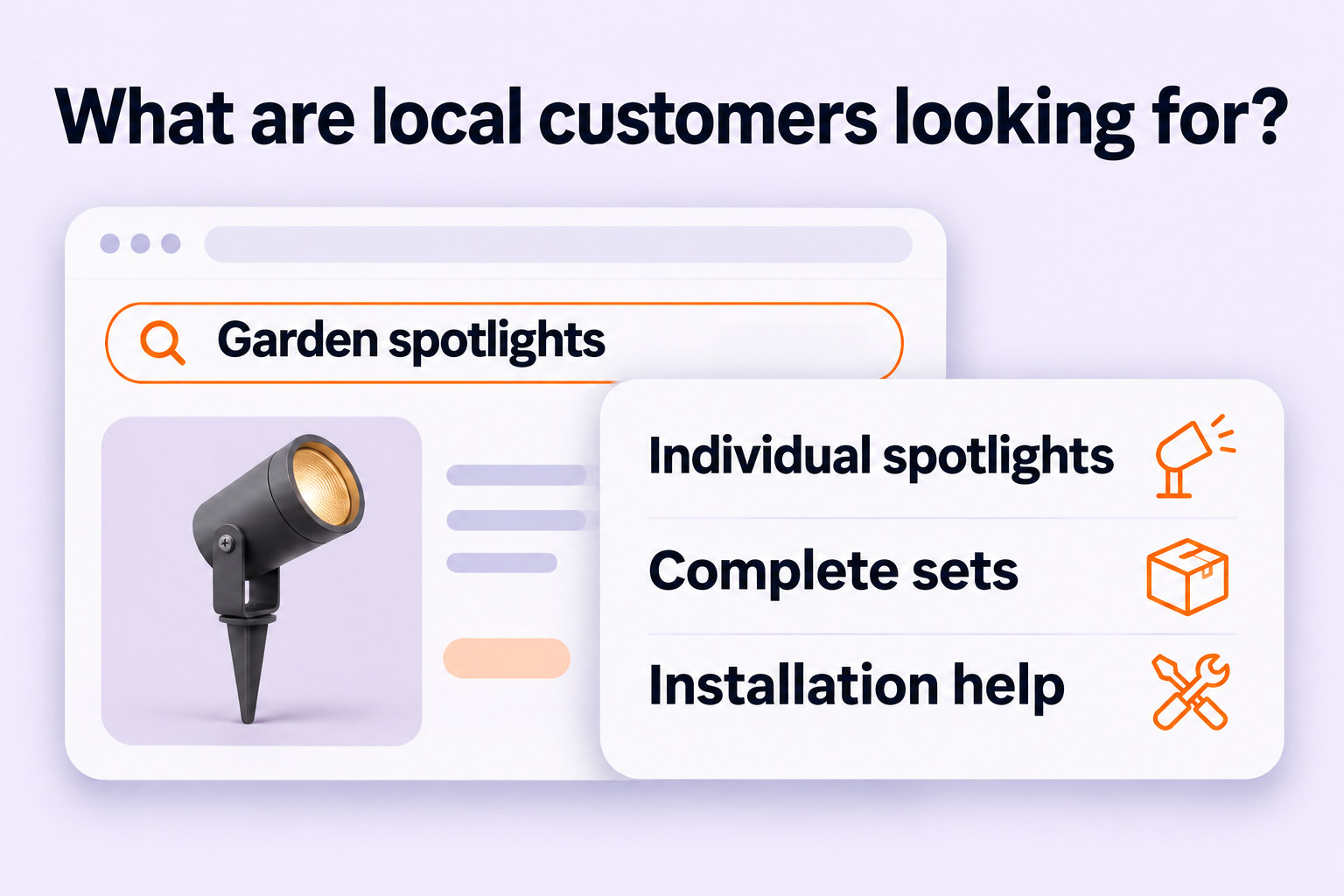
Suppose garden spotlights are performing well in your Dutch online store. The category attracts visitors through product-focused searches and generates orders. In that case, research how people in Belgium, Germany, and France search for similar products.
Use local keyword research to find out which product names customers use. A literal translation of a Dutch keyword may be unusual in another country. Look at which providers and pages appear in local search results to better understand local search intent.
Are customers looking for individual garden spotlights, complete sets, or installation assistance? That distinction determines which products you highlight and what information your online store should provide.
See where you’re already getting international visitors and orders
Check Google Analytics to see which countries your visitors come from and which pages they view. Review the orders and delivery countries in your online store’s administration. Analytics estimates visitor location based on the IP address. To determine where you actually deliver, use the delivery country.
In Search Console, filter the performance report by country and then review the search queries and pages. Search queries containing your company name help you see where people already recognize your brand. Product-focused search queries give you insights to explore demand for your offerings.
Do you get few visitors from a particular country? Then check how visible you are there right now. If your online store barely shows up in local search results, there may be demand that you’re not yet reaching with your current site.
Case study featuring Belgium, Germany, and France
A fictional Dutch online store selling outdoor lighting compares three countries for the “garden spotlights” category. In the Netherlands, this category attracts visitors via Google and generates orders.
Country | What does the online store see now? | What is the team researching? |
|---|---|---|
Belgium | The online store is already receiving orders and visitors through product-focused search queries. | Which products do customers order, and how much additional demand can the online store generate in Flanders? |
Germany | The online store receives limited traffic. | How high is the search volume for garden spotlights, and which providers dominate the search results? |
France | The online store receives very few visitors. | What product terms do customers use, and what information and services do they expect? |
In Belgium, the team can use existing orders and customer inquiries to further investigate which products are popular. For Germany and France, the team gathers more information from local search results and competitors’ offerings. For all three markets, the team analyzes search queries, competition, and feasibility.
Take competition, effort, and lead time into account
High search volume makes a market attractive. How much of that demand you can capture also depends on the competition and your team’s capacity. In his Brighton approach, Niels uses four factors to estimate the expected organic traffic per market.
Effort. How much time and resources do you have for local keyword research, content creation, and building authority?
Lead time. How much time will you give the new version of the online store to build visibility?
Competition. Which providers already rank highly for the search terms that are important to you?
Search results. How much space do organic results get next to ads, product listings, and other elements on the search results page?
Also include delivery, returns, and customer service. When choosing your market, you’ll want to know how many customers you can reach and whether you can process the expected orders at a cost that fits within your margin.
Set up your online store for the selected market
Suppose the outdoor lighting e-commerce site chooses to target Flanders. Research shows that customers are already ordering garden spotlights there, that there is additional search demand, and that the team can handle shipping and returns. Therefore, it prioritizes the garden spotlights category when setting up the Belgian version.
When tailoring your online store to local customers, you also need to consider the words they use and the information they need to place an order. The team therefore incorporates the product terms used by Flemish customers and specifies the delivery times, return policies, and support they can expect. If you then decide to enter a market with a different language, you can make your online store multilingual and tailor the content to that market as well.
Clonable allows you to centrally manage your international online stores. You maintain product information from your existing online store and adapt text for each market as needed. Your team or agency conducts local keyword research, optimizes the pages, and tracks the results.
Create a shortlist of promising markets
Choose a few product groups that generate orders in your home market. For two or three countries, compare local search demand, competition, the effort required, and the feasibility of delivery, returns, and customer service. Include existing traffic and orders as indicators of the demand you’re already reaching.
For each country, document what data you have, what assumptions you’re making, and what you still want to investigate. This will help you justify which market should receive priority and which product group you should develop first for that market.
Get started with Clonable for free today
Discover how to centrally manage international websites from a single platform.