
Part 3: How Long Does International Web SEO ation Take? Why, as an SEO Specialist, You Should Never Promise ROI in Year One
The budget is finalized. As an SEO specialist, you’ve convinced management to make a serious investment in localization—not a cheap “Translate & Pray” approach, but a solid one. You’re feeling good. But then the CEO asks the question you actually saw coming: “Great plan. But how soon will we see those results in Germany?”
I have to admit: in my early years as an SEO specialist, I struggled immensely with this question. I often chose one of two extremes. Either I was far too optimistic and promised a massive traffic spike in month three, because I was truly convinced that things would turn around quickly. And maybe also a little bit to keep the client or management happy. Or I’d be extremely cautious and act as if SEO were an inscrutable black box that would take years to yield results. With either answer, you run the risk of losing your credibility.
In the first article in this series, we showed how to calculate a baseline for a new market based on performance in your home market. In the second article , we added the “Effort” modifier: how much of that potential can you realistically tap into based on the time, budget, and capacity you invest in the new market? But even if you have that budget available, there’s still one factor you can’t completely ignore: time.
An additional budget can speed up a lot of work. You can localize faster, implement technical improvements, optimize content, and build local authority. But you cannot force new pages to be crawled, indexed, and ranked highly immediately. That is why we add the Time modifier (T) to our forecast model. The T-factor adjusts the expected organic growth to account for the time a new market needs to build traction.
Disclaimer: The T-factors below are assumptions within this forecast model, not universal SEO benchmarks. The speed at which a new market gains traction varies by website, market, competition, and approach. The factors primarily help you explicitly factor time into your forecast.
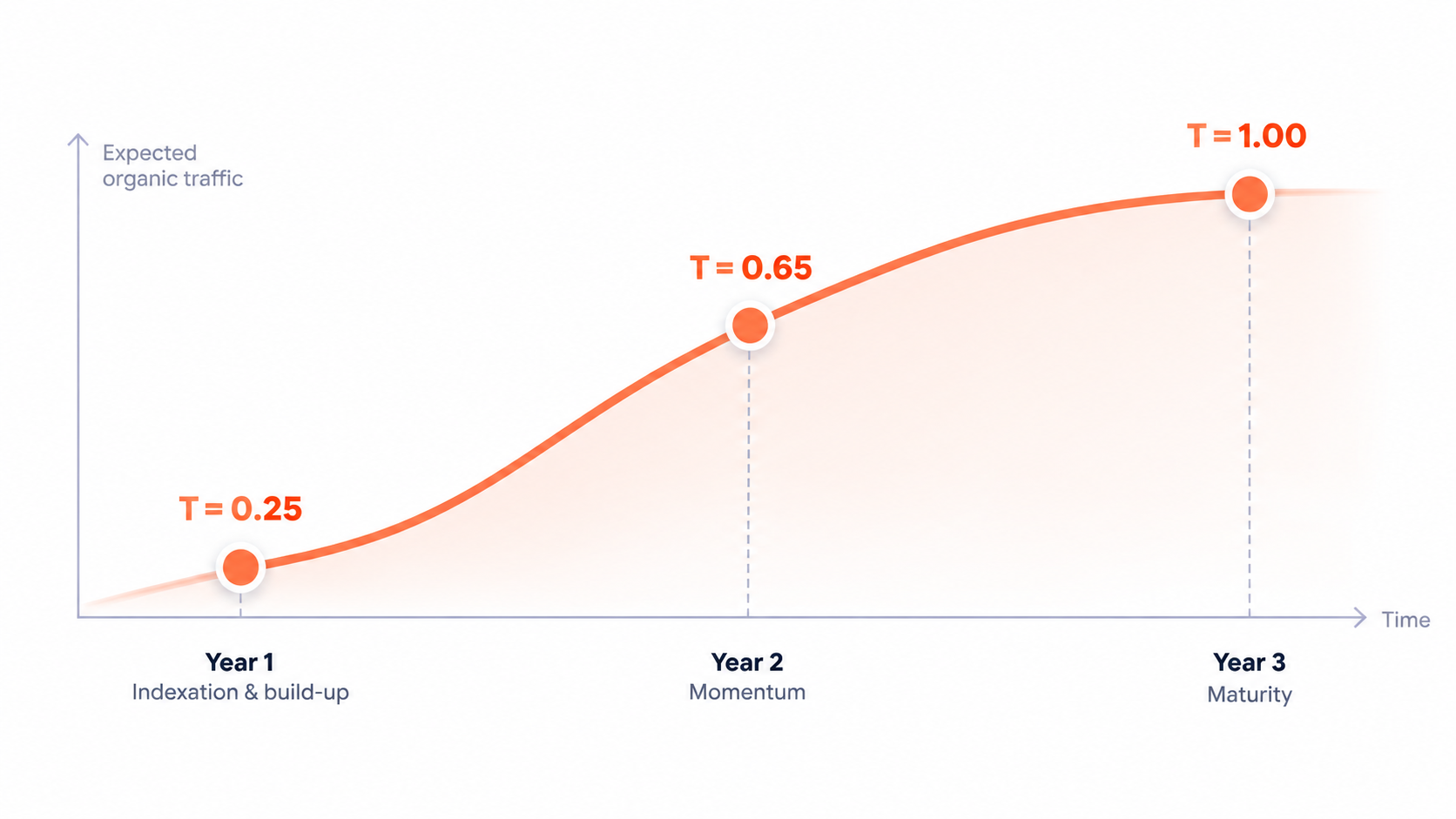
Year 1: Indexing and Development (T = 0.25)
When you launch a new international version of a website, Google and other search engines must first discover and crawl the new URLs. Pages must then be indexed and build rankings for relevant search queries.
For a large e-commerce website with hundreds of thousands of localized URLs, simply discovering, crawling, and processing new pages can take time. Furthermore, crawling does not automatically mean that every page is indexed immediately. And indexing is just the beginning. Your German pages will not automatically achieve the same rankings as comparable pages in your Dutch home market. They must build their own rankings within a different search market, with different competitors, search results, and local signals.
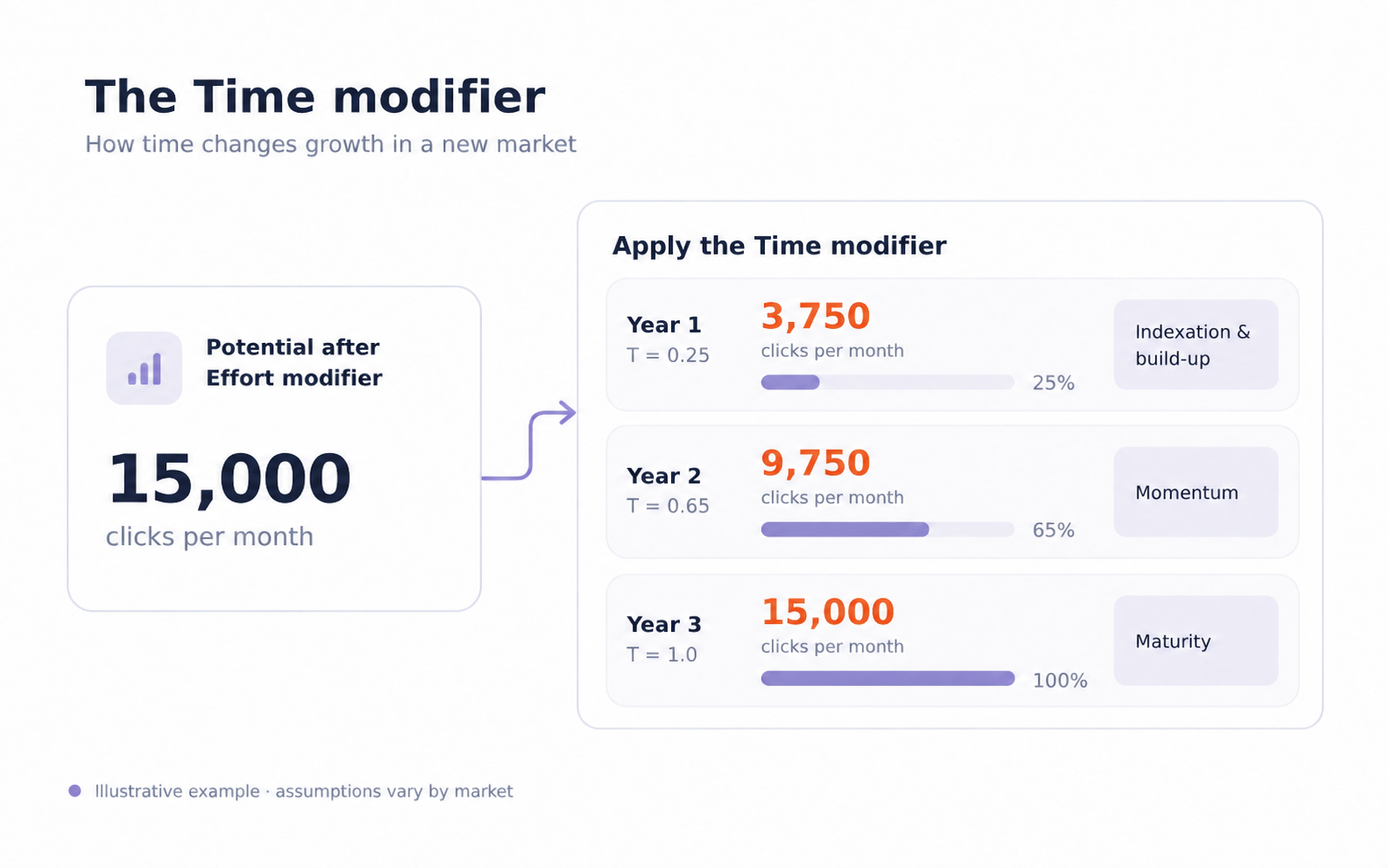
Therefore, in our forecast model, we conservatively apply a T-factor of 0.25 for the first year. So we do not assume the full calculated potential, but instead model approximately 25% of the traffic remaining after the Effort modifier in year one. This does not mean that every website will achieve exactly 25% in year one. It is a deliberate assumption that prevents your forecast from assuming a mature organic position from day one.
My advice for the boardroom: don’t promise that you’ll realize the full return on the ultimate SEO potential in year one. Make it clear from the outset that the first year is also about indexing, building rankings, and establishing a foothold in the new market.
Year 2: Momentum (T = 0.65)
By the second year, you’ve built up more history. Important pages have had more time to develop rankings, you’ve likely implemented more local optimizations, and local backlinks and other signals can further contribute to your visibility. You also now have data from the new market. You can see which pages and keywords have potential, where optimizations are having an effect, and where extra attention is needed.
In our model , we therefore increase the T-factor to 0.65. In year two, we thus factor in approximately 65% of the traffic remaining after the Effort modifier. Again, this is not an SEO benchmark, but a model assumption that allows us to factor in a gradual build-up in the forecast.
Year 3: Maturity (T = 1.0)
In the third year, we treat the market within the forecast model as mature. That does not mean that SEO growth stops after three years. You can still gain market share, develop new content, and achieve better rankings. A T-factor of 1.0 simply means that, from this point on, we no longer apply an additional adjustment to account for the fact that the market is new.
From that point on, the model assumes 100% of the traffic remaining after the Effort modifier. This removes time as an inhibiting factor from the calculation.
Why this is your lifeline in the boardroom
It can feel uncomfortable to tell management or a client that organic growth takes time. But by making that expectation explicit from the start, you prevent a realistic growth trajectory from being viewed as a disappointing result later on.
Suppose that by month eight, you’ve only achieved 20% of your ultimate traffic goal. Without factoring in time, this might appear as though the international strategy is falling behind. Within a forecast that assumes a gradual build-up from the start, that same result can fit much better within the expected trajectory. You make it clear in advance what development you expect and what assumptions underlie it. You can’t completely eliminate the time factor, but by including the Time modifier in your forecast, you can account for it realistically.
And we’re not done yet. So far, we’ve looked at the potential of your home market, the investment you’re willing to make, and the time it takes for a new market to gain traction. But two countries with the same search query, the same budget, and the same timeline can still yield completely different results. Why? Because in one market you might be up against a few weak competitors, while the SERP in the other market is dominated by strong local players.
In the following article, we will therefore add the following factor to the forecast model: the Competition modifier. This allows us to adjust the forecast for the level of competition in your new market.
By: Niels Arts
Get started with Clonable for free today
Discover how to centrally manage international websites from a single platform.