
Part 2: Translating a Website for SEO: Why “Translate & Pray” Sabotages Your International Growth
You’ve taken the first step. In the first article in this series, we showed how to calculate, based on your home market, the maximum amount of organic traffic you can expect in a new target country. That calculation gives you your baseline. Let’s say: 30,000 clicks per month. But that baseline doesn’t yet tell you how many of those you’ll actually achieve. To determine that, we need to look at a second factor: how much budget and capacity are you investing in that new market?
Because let’s be honest: that baseline assumes you’ll invest roughly the same amount of budget, capacity, and blood, sweat, and tears into that new market as you have in your home market over the past five years. Does that happen in practice? Almost never. Certainly not for a first launch across borders. Your final “ SEO ” forecast is strongly determined by the effort you put in. In our forecasting model, we call this the Effort Modifier (E). We roughly divide that effort into three scenarios. The scenario you end up in has a major impact on how much of your SEO potential you actually realize.
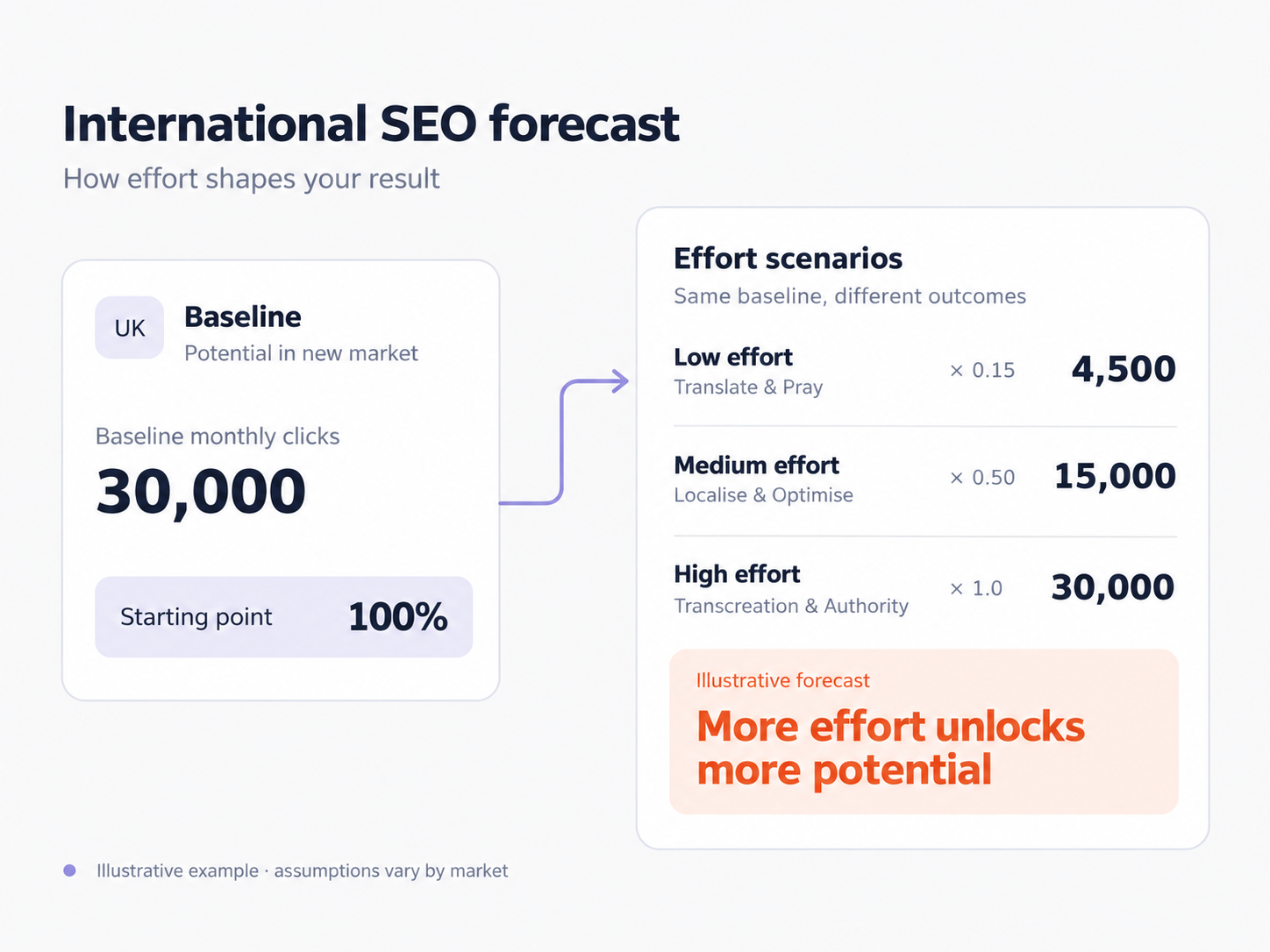 Scenario 1: Low Effort / “Translate & Pray” (E = 0.15)
This is the classic pitfall of a rushed expansion. What does this look like in practice? You run your entire website through an automatic translation plugin, set your hreflang tags correctly, and publish everything. Done. You press a button and hope for the best. No local keyword research, no customized URLs, and no local link building.
Why does this often fail? Because you’re missing the local search intent. A literal translation may be grammatically correct, but that doesn’t mean you’re using the terms people in that market actually search for. In our model, you should assume about 15% of your baseline potential in this scenario. Your website is available in the local language, but you’ve done little to build local relevance and authority.
Scenario 2: “ Medium ” Effort / “Localize & Optimize” (E = 0.50)
For many companies, this is a logical middle ground. You want to compete seriously and convert locally, but you don’t yet have the budget for a local PR agency and full-time copywriters. Here, you do conduct local keyword research in the target language. You link those keywords to the appropriate URLs. You optimize your title tags, meta descriptions, and headers based on local search behavior. You also have key content reviewed or edited to ensure it naturally aligns with the local market.
In our model, this approach assumes approximately 50% of your baseline potential. This is also the point at which capacity often becomes an issue. Manually translating and optimizing thousands of pages takes a lot of time. This is where localization software such as Clonable can take over part of the work. Clonable automates the translation and synchronization of your website, allowing your SEO specialist to focus on local search behavior and optimization.
You get a strong translated foundation, while retaining the ability to customize keywords, metadata, and specific phrasing at the URL level. This makes Localise & Optimise more scalable, without a large portion of your SEO budget being spent on manually translating and updating content.
Scenario 3: High Effort / “Transcreation & Authority” (E = 1.0+)
This is the most comprehensive approach. You don’t just translate; you rewrite content specifically for the local culture and market. For example, you work with local digital PR agencies, actively build local backlinks, collect local reviews, and adapt your schema markup to local entities.
Your E-factor is 1.0. Within our model, this means you unlock 100% of the calculated SEO potential in the new country. In some cases, the factor may even exceed 1.0, for example when local competition is relatively limited. But let’s be realistic: virtually no company starts with Scenario 3 right away in year one.
The lesson for the boardroom
What does this mean for your international SEO forecast? You can’t expect Scenario 3 results when working with a Scenario 1 budget. So if management asks why the expected ROI is lower than in the home market, part of the answer lies in the investment you make in localization and local SEO.
Do you want to build a strong position in a new market? Then you need to optimize locally. Use tools and software to speed up the groundwork and invest the hours you save in understanding your new customer’s search intent. Stop with “Translate & Pray.” It’s time to truly localize.
But effort isn’t the only factor that determines how much results you’ll ultimately see. Time also plays a major role. You can invest heavily in a new market, but organic growth cannot be accelerated indefinitely. In the next article, we’ll therefore examine the third factor in our forecast model: the Time modifier. How soon after an international launch can you realistically expect to see SEO results?
By: Niels Arts
Get started with Clonable for free today
Discover how to centrally manage international websites from a single platform.