
Part 4: International SEO forecast: factoring in competition and SERP features
You’ve used your home market as a blueprint, determined your scope, and explained to management that international SEO takes time. In the previous three articles, we used this to establish the baseline, the Effort modifier, and the Time modifier. But one reality check is still missing: your home market is not identical to your new target market.
Many companies make the mistake of blindly extrapolating their current dominance to foreign markets. A market where you face relatively little competition in the Netherlands can be much more challenging in the United Kingdom or the United States. Your current rankings therefore do not automatically say anything about your chances in a new market. And even if you achieve the same positions there, that does not automatically result in the same share of clicks. The layout of the search results page also plays a role. That’s why, in this final article, we’re adding two more factors to the forecast: competitive pressure and SERP features.
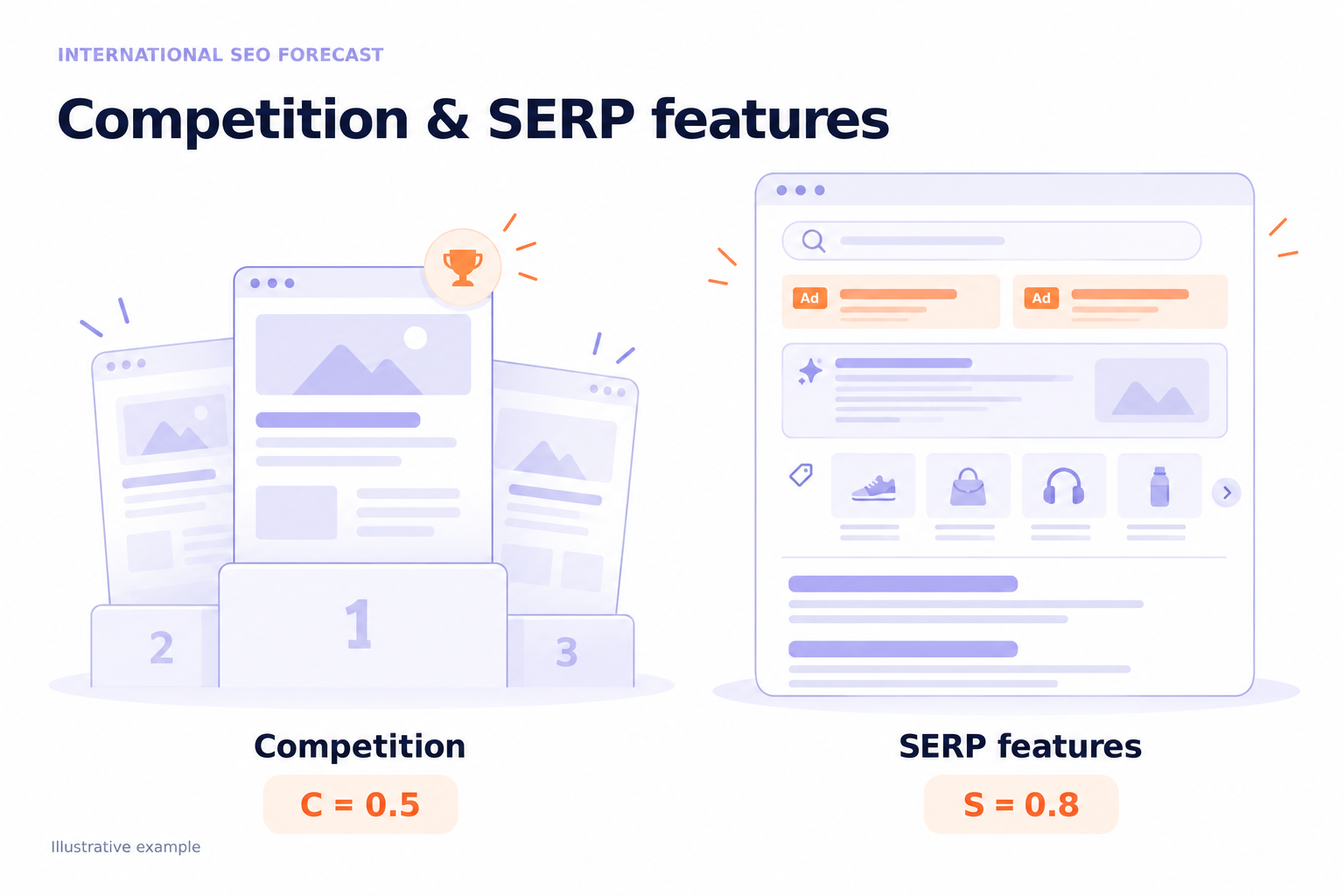
The Competitor Density modifier (C)
How strong are the websites you’ll soon be competing against? That makes a big difference to your chances of ranking at the top of search results. For this model, we use the average Keyword Difficulty (KD) as an indicator of ranking difficulty in both markets. To do this, compare corresponding keywords using the same SEO tool. Use the local search terms you’ve actually included in your forecast so that you’re comparing keywords with similar search intent.
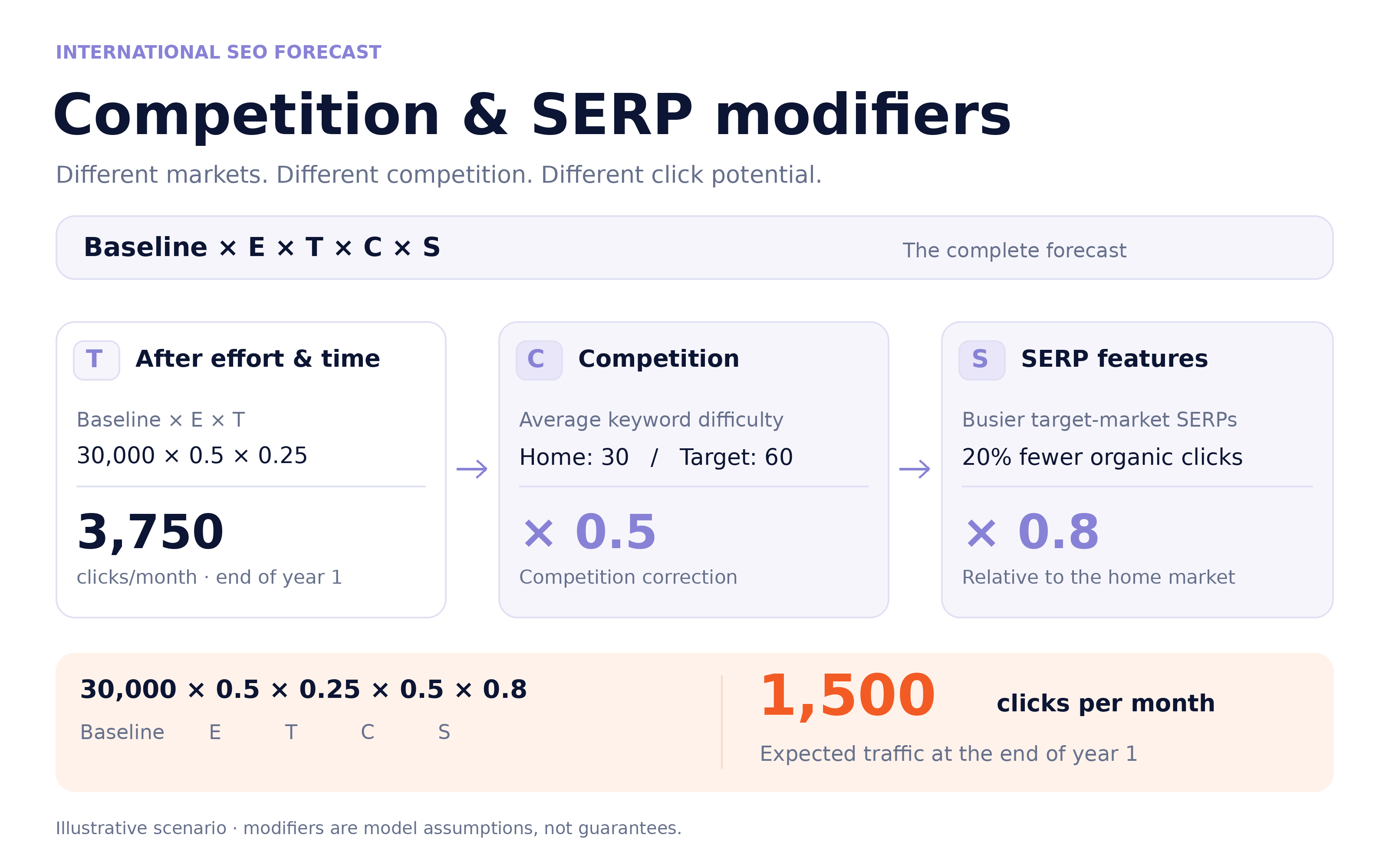
Next, we divide the average KD of the home market by that of the target market: C = average KD of the home market / average KD of the target market. Suppose the average KD of your most important search terms in the Netherlands is 30 and in the United Kingdom is 60. Within this model, that yields a C-factor of 30 / 60 = 0.5. We therefore multiply the forecast by 0.5, thereby halving the expected organic clicks.
This is a practical model assumption. KD varies by tool and does not necessarily form a linear scale. A score of 60 therefore does not automatically mean that a market is twice as difficult as one with a score of 30. Nor does doubling the KD mean that, in practice, you’ll get exactly half the traffic. Therefore, use the C-factor to adjust your expectations and verify whether it aligns with the competitors you actually encounter in the search results.
The SERP Feature Modifier (S)
Even if you rank in position 1, the search results page determines how much attention and how many clicks you receive. In your home market, organic results may be relatively prominent. In your target market, ads, Shopping results, AI Overviews, and local results may take up a lot of space. Your organic No. 1 result may be at the top of the organic results, but it could be much further down the page. Furthermore, some elements may already answer the user’s query, so they no longer need to click through to a website. As a result, the same search volume and the same organic position may still yield fewer clicks.
To account for this difference, we use a manual correction factor: the S-factor. Since the baseline is already based on your home market performance, we look at the difference between the search results pages in both markets. Are they comparable? Then we use S = 1. Are the search results in your target market clearly more crowded? Then, within this model, we choose a factor between 0.5 and 0.8, for example. This reduces the expected organic clicks by 20% to 50%.
These values are assumptions within the model. Determine the adjustment based on the keywords in your forecast. Look at where the organic results appear, what additional elements show up, and how much space they take up. A general impression of the target country is not sufficient for this.
The complete forecast
With these last two factors, the model is complete: Baseline × E × T × C × S. The baseline indicates click potential based on your home market performance and the search query in the target market. The Effort modifier adjusts for your level of effort. The Time modifier accounts for the time required to build the campaign. The C factor accounts for competitive pressure, and the S factor accounts for variations in the search results page.
Let’s use the baseline of 30,000 clicks per month from the previous articles. In this example , we’ll opt for local optimization with E = 0.5 and examine the end of Year 1 with T = 0.25. Using the competition factor from the example above, C = 0.5, and a SERP adjustment of S = 0.8, the calculation becomes: 30,000 × 0.5 × 0.25 × 0.5 × 0.8 = 1,500 clicks per month. That is the expected monthly number of organic clicks at the end of Year 1 in this scenario. It is not a total for the entire year.
The goal is not to predict the future exactly. The goal is to make the key assumptions visible before you present a number to management. Why do you expect this traffic? What resources does that require? And what circumstances could change the outcome? Actual performance never follows the formula as closely as it suggests. Rankings can rise or fall more quickly, and a single important keyword can already have a significant impact on the outcome.
Therefore, view the outcome as a well-founded scenario assessment, not as a guarantee. By varying the assumptions, you can also calculate a conservative and a more ambitious scenario. This demonstrates how sensitive the forecast is to your choices and the conditions in the target market.
Make room for local optimization
But how do you free up enough capacity to compete in that market without your budget being completely consumed by translation work? If your team spends dozens of hours each week manually translating product pages, there’s less capacity left for local optimization and link building. Yet it is precisely that work that determines how well you connect with the new market.
By using a platform like Clonable for the basic translation and management of your multilingual site, you free up capacity for your SEO specialists. They can focus on the work that requires local expertise: keyword research, adapting metadata and content to local search intent, and building authority. Translation is therefore only the first step. SEO growth ultimately comes from local relevance, authority, and a strong alignment with search results in that market.
A good international SEO forecast clearly outlines the potential you see, the effort required, and when you expect results. This provides management with a well-founded expectation and gives your team a concrete starting point to work from.
By: Niels Arts
Get started with Clonable for free today
Discover how to centrally manage international websites from a single platform.